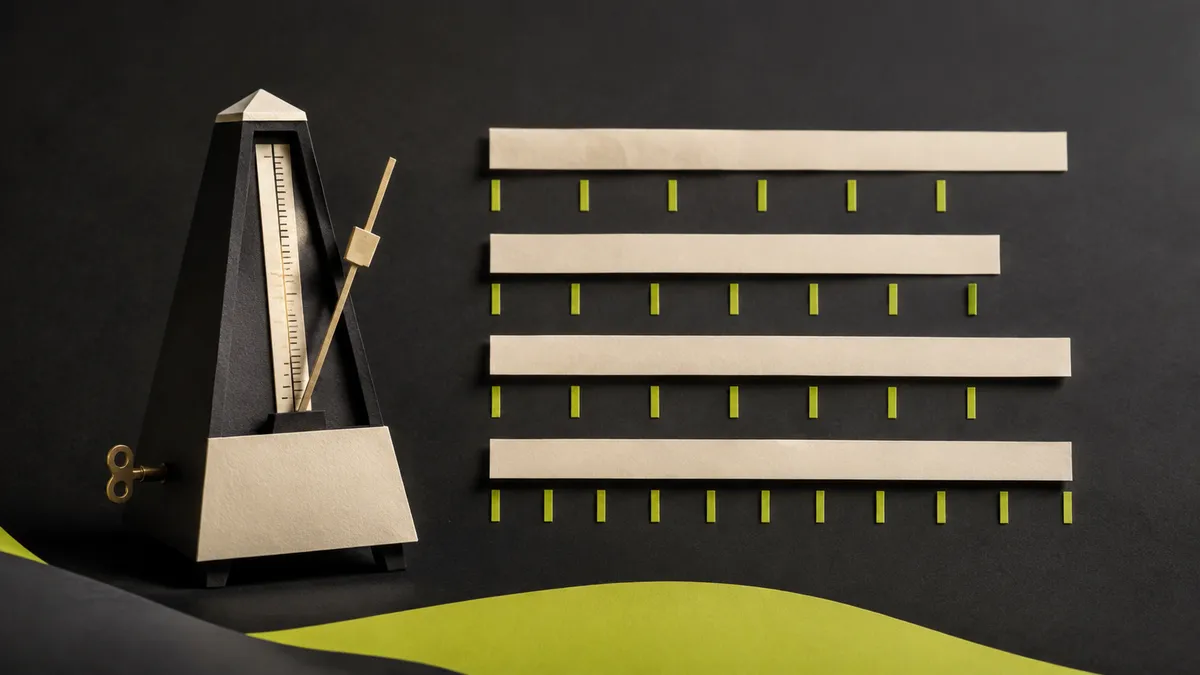
Separate chord changes from surface activity
Harmonic rhythm means the timing and rate of chord changes. A recording can contain many notes while holding one harmony, or change chords rapidly over a sparse texture. Tap the main pulse and listen for the moments when the underlying harmony moves. Write the chord durations in beats or measures. Do not count every guitar stroke, bass ornament, or vocal note as a new chord. The purpose is to identify the stable harmonic schedule beneath the more detailed rhythmic activity of the arrangement.
Play only the change points
Use one sustained chord attack at each verified change and count aloud through the spaces. If a chord lasts six beats, keep counting rather than ending it after a familiar four-beat pattern. If two chords share a measure, place both accurately before adding decoration. This sparse exercise makes timing errors easy to hear. Compare your work with the recording and use the AudioChords sequence as a starting reference. When a label appears surprisingly often, investigate whether it represents a real harmonic event or a brief passing sound.
One progression, two different schedules
Play C, Am, F, and G in 4/4, first giving every chord four beats. The sequence takes four bars. Now play C for six beats, Am for two, F for four, and G for four. The total is still sixteen beats, but Am now arrives on beat three of bar two. Write the second version as bar one C; bar two C on beats one and two, Am on beats three and four; bar three F; bar four G. Chord order alone cannot communicate this difference.
Strum straight eighth notes through both versions, counting one-and-two-and-three-and-four-and. There are eight strokes in each bar but not eight chord changes. Next remove every stroke except the first attack of each harmony. If the sparse version still has the right movement, you have separated harmonic rhythm from the surface pattern. Record both versions yourself and ask a practice partner to say which schedule they hear without seeing your hands.
Fit the accompaniment around the map
Add a strum, repeated keyboard chord, or picking pattern while preserving the change points exactly. Be willing to shorten a pattern when the next harmony arrives. Practice the most irregular measure with a lead in and an exit so the change feels connected to the phrase. Then sing or hum the melody over the accompaniment. Harmonic rhythm often explains why an otherwise correct chord chart sounds wrong: the names fit, but their durations do not. A clear timing map lets you simplify the texture confidently without losing the composition's movement or arriving at a new section a measure too early.
Fit the pattern to the change
The diagnostic question is what happens when the pattern and the chord boundary disagree. In the second version, change to Am on beat three even if your memorized picking cycle is unfinished. Shorten or restart the pattern; do not extend C to preserve a convenient hand movement. If an AudioChords label appears between your counted beats, listen for an anticipated chord attack rather than snapping it automatically to beat one. Some arrangements really do move early. Keep separate notes for the audible onset and your simplified practice choice. Finish by playing the final G into the first C of the repeat: harmonic rhythm includes the boundary between cycles, where an extra beat can easily sneak in.